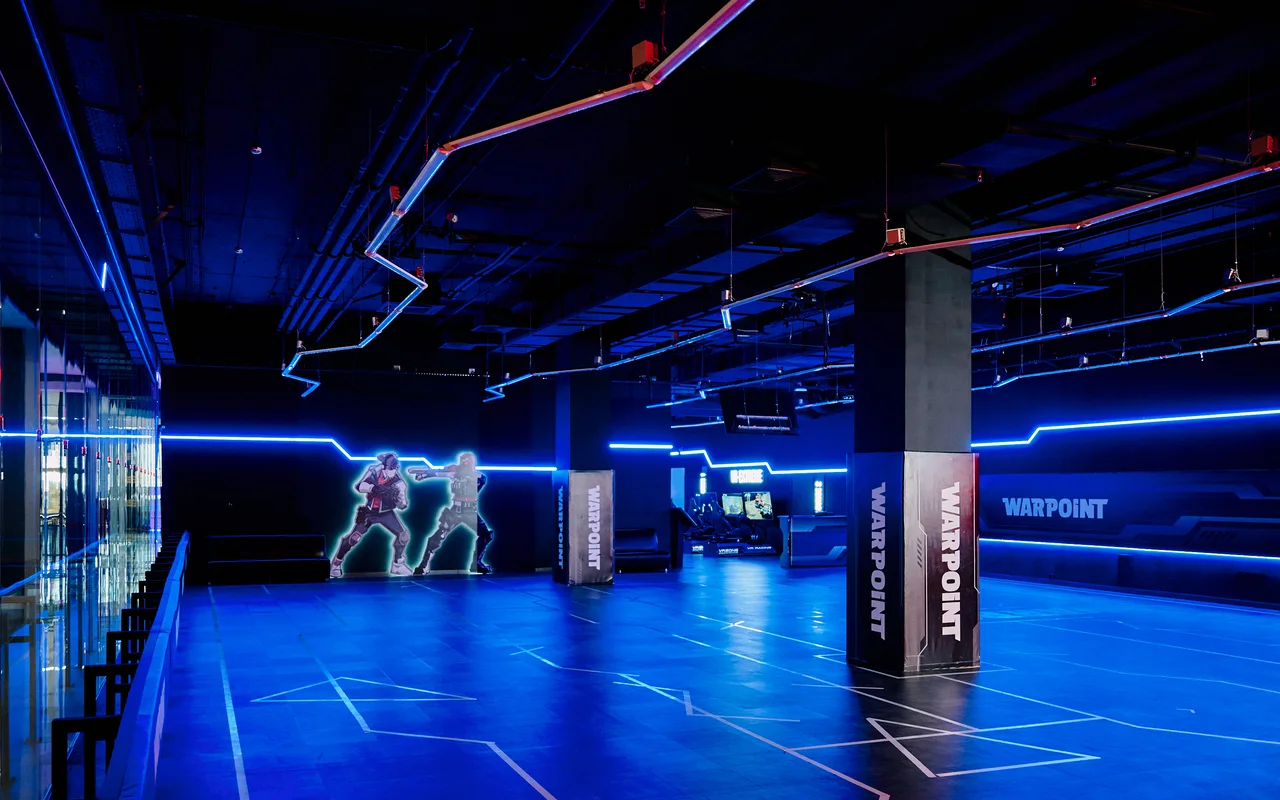
The question “how much does it cost to open a VR arena” almost always means two different questions: how much you need to open, and how much you need to survive until the business turns a profit. Below are both answers, with a breakdown by line item and the entry points of three formats.
Short answer
The ARENA format starts at $55K: a hall from 150 m², equipment, fit-out and launch. The PARK format starts at $120K. A subscription, where the equipment is not bought but paid for monthly, starts at $10,000.
What the sum is made of
Start-up investment is not one figure but seven line items. Their proportions change from city to city, but the list is the same everywhere:
- Franchise fee — $15,000 in the ARENA format. This covers the right to operate under the brand, access to the game library, training and launch support
- Equipment — headsets, computers, the tracking system, the network. The largest item, and the one that sets how many people the hall can take at once
- The premises — fit-out, electrics, ventilation, lighting. The hall has to be empty and level, so remodelling is needed more often than not
- Lounge and furniture — the waiting area where guests spend time between rounds and leave the second half of their bill
- Software and the management system — booking, the till, occupancy analytics
- Launch marketing — the first guests do not arrive on their own: you need photography, advertising and work with map services
- Working capital — rent, salaries and advertising for the first months while occupancy is still growing
That last item is the one most often forgotten. An arena does not reach working occupancy in its first month, and the reserve for that period is as compulsory as the equipment itself.
Three formats and their entry points
The network has three ways into the business, and they differ not in quality but in the size of the hall and in whether you buy the equipment or pay for it monthly.
- ARENA — from 150 m², investment from $55K, income from $11,000 a month, payback from 10 months
- PARK — from 400 m², investment from $120K, income from $24K a month, payback from 14 months
- Subscription — investment from $10,000, income from $4,000 a month, with no franchise fee and no royalties, under your own brand
How the subscription differs in money terms
Under a subscription the equipment stays the property of the network and you pay for it monthly. The entry point drops roughly tenfold: instead of buying headsets and computers you need only the first payment and the preparation of the premises. The price of that low entry is the monthly payment itself — it runs for as long as you operate, whereas bought equipment has paid for itself within a year or two.
This route makes sense when the premises are already there but $55K is not, or when you want to test the format before committing in full.
What changes the total
- The city. Fit-out and rent in a large city and in a town of 300,000 differ several times over; the equipment costs the same
- The state of the premises. A ready hall in a shopping centre with electrics and ventilation is one budget; a former warehouse is quite another
- Floor area and the number of headsets. A 150 m² hall and a 400 m² hall differ in more than rent: the second needs more equipment, but it also earns more
What goes out every month
An arena's running costs are rent, payroll for three or four staff, marketing and royalties. Royalties in the network are 7% from the fifth month of operation: for the first four months, while the business is ramping up, there are none.
In the network's worked example — ten headsets at 45% occupancy — operating costs take about 60% of revenue, and the rest is profit. Treat that as a reference point, not a promise: the share taken by rent differs between a small town and the centre of a large city.
When it pays back
Payback periods by format are: ARENA from 10 months, PARK from 14, subscription from 6. The average revenue of a single arena in the network for 2025 was $13K a month.
Those periods are counted from the day the arena reaches working occupancy, not from the day the contract is signed. Between the two lie the fit-out, the equipment delivery and the first weeks of operation — budget for that gap separately.
How to work it out for your own city
There is no universal figure: it comes out of the rent in your city, the state of the premises and the format you choose. The calculator on this site assembles those inputs into a five-year financial model — revenue, costs, taxes and the payback point. A projection for a specific address and city is prepared by the team on request.