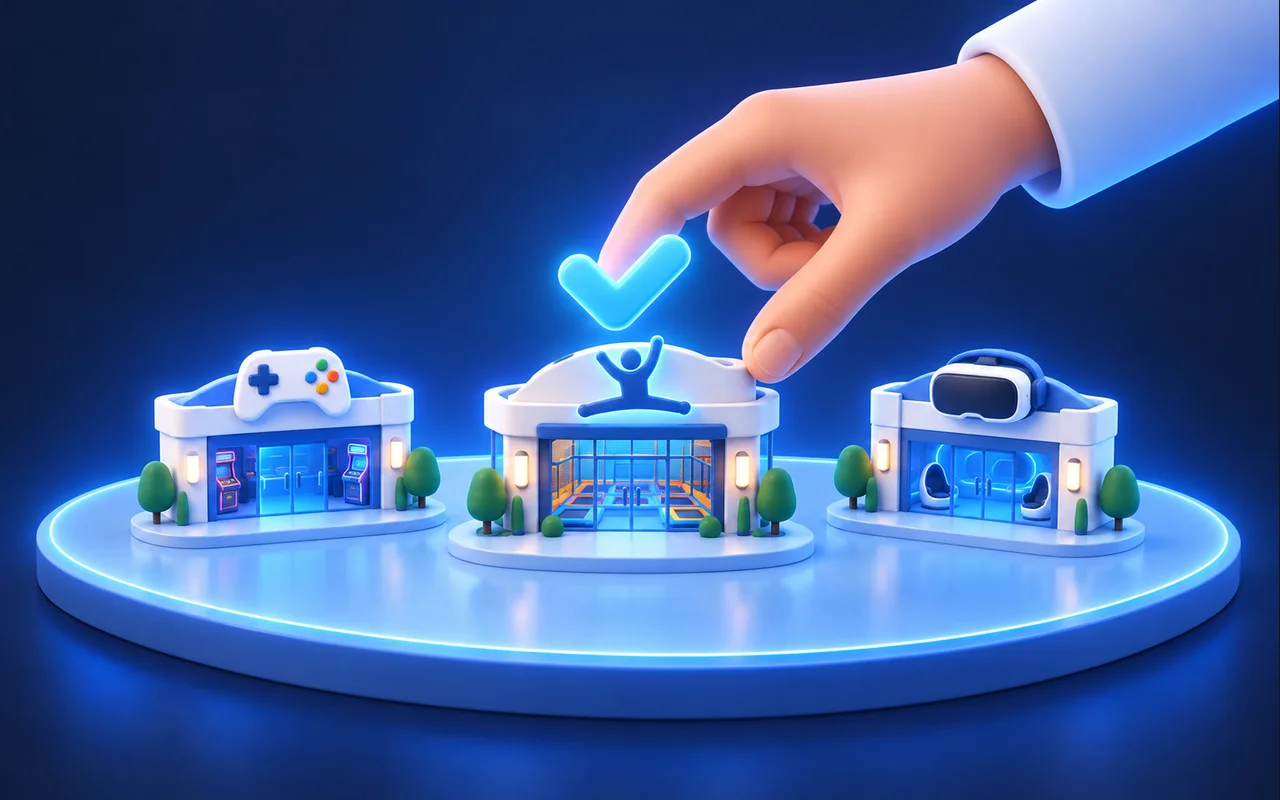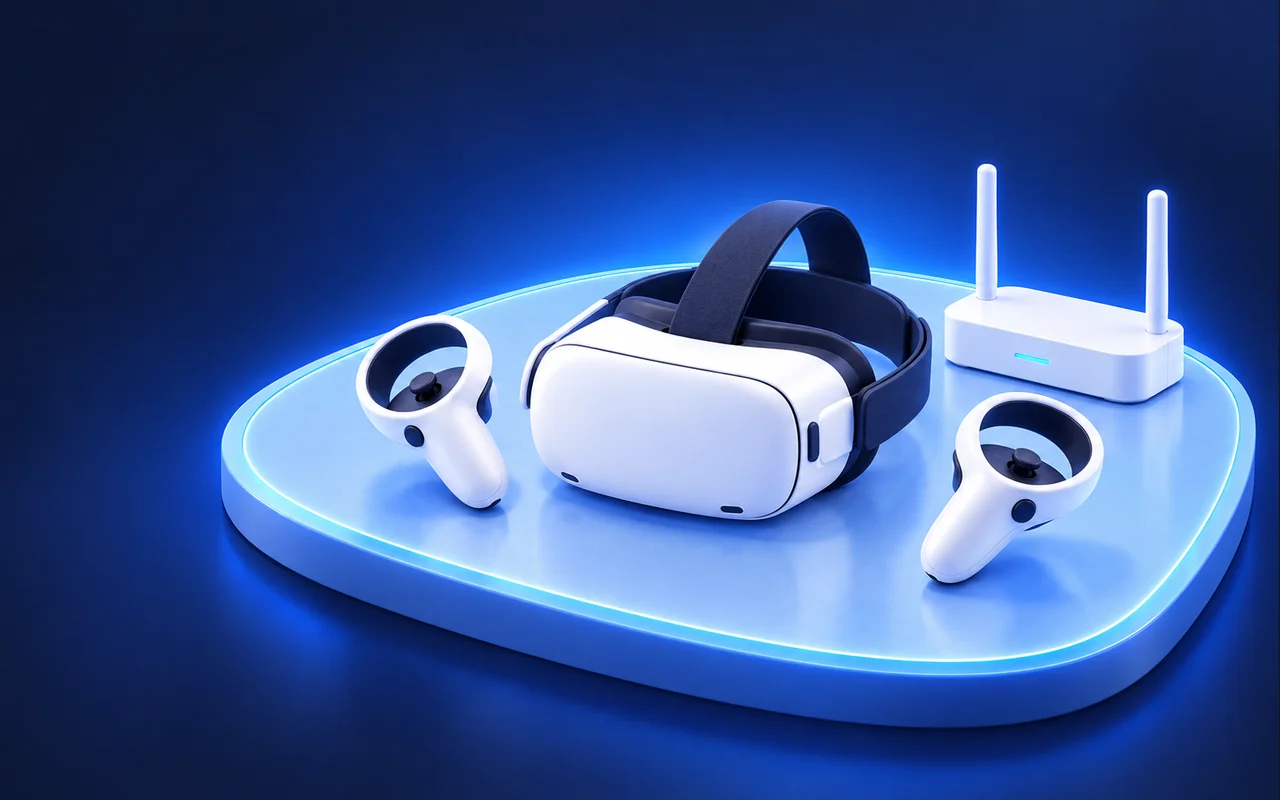
"VR in a shopping mall" covers two fundamentally different formats with different economics. We look at how they differ and why an arena usually has both.
The word "VR" on the market hides things that cannot be compared either by experience or by investment. There are two main formats.
Stationary VR
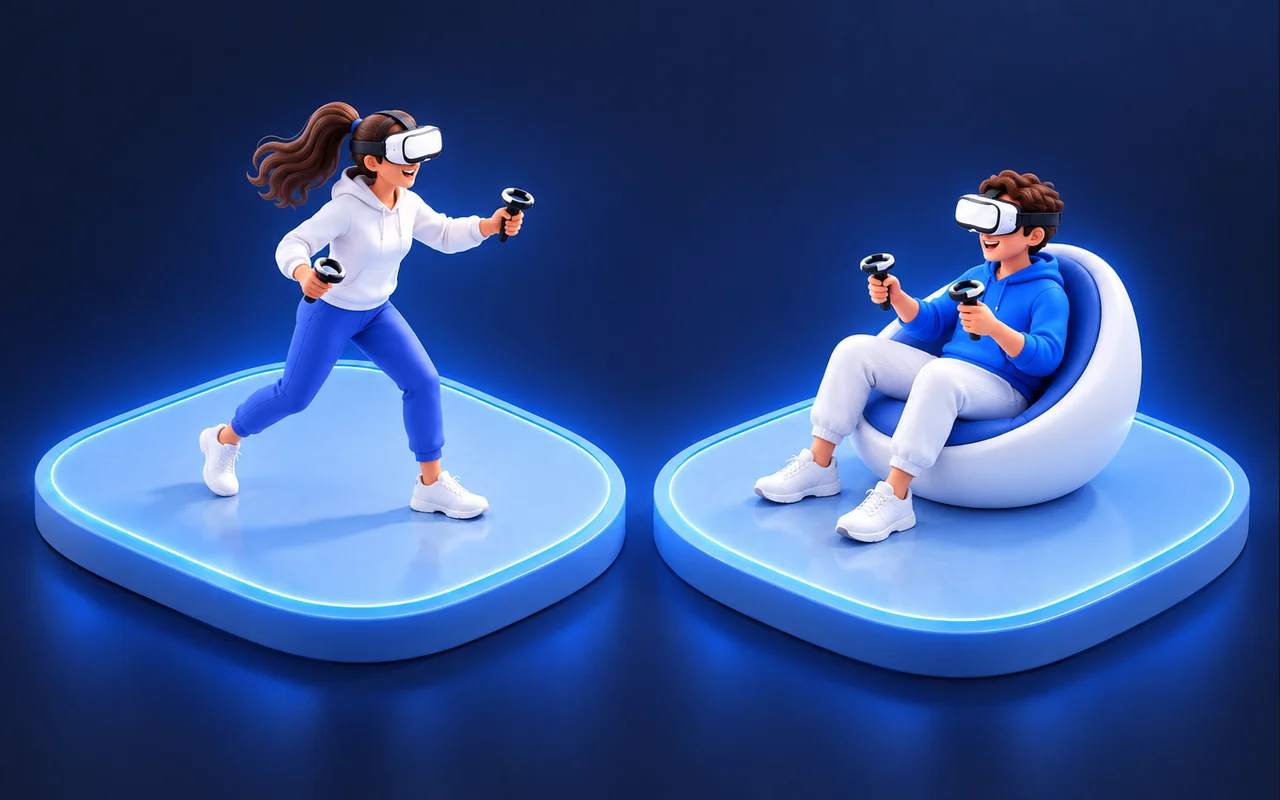
The guest stands or sits on a dedicated platform a few square metres in size. Movement in the game is by controller, not on foot. This also includes attractions with motion platforms: coasters, flights, simulators.
- Needs little space — a station can stand in a mall walkway
- Short session, fast turnover of guests
- Works as a one-off experience: tried it, moved on
- One guest per station, a group plays in turns
Free-roam
A marked-out hall that players walk through on their own feet. Up to ten people at once in one space, seeing and interacting with each other.
- Needs an unobstructed hall with spare height
- The session is longer, the guest comes deliberately rather than in passing
- It is a team entertainment — the reason a group gets together
- The basis for events: birthdays, corporate parties, team building
The key difference in one line
A station sells an experience to one person. Free-roam sells an event to a group — which is why the share of arena revenue that comes from events rests on it.
Comparison by parameter
| Parameter | Stationary VR | Free-roam |
|---|---|---|
| Space required | Small, a few m² per station | An unobstructed hall from 150 m² |
| Players at once | Usually one | Up to ten in one space |
| Type of visit | Spontaneous, in passing | Planned, by booking |
| Suitability for events | Limited | The core format |
| Premises requirements | Minimal | Geometry, ceilings, light, ventilation |
| Barrier to entry for a competitor | Low | High |
Why a park has both
The formats do not compete — they complement each other. In the PARK format VR stations, extreme attractions and racing simulators work alongside the arena, and this is not variety for its own sake.
- Extending the visit. The group has played a round in the arena — it goes to the simulators instead of leaving
- Different ages. While the teenagers are in the arena, the younger child is busy at a station
- Waiting. Stations keep guests occupied while they wait for their session
- Average bill. More activities per visit means a higher total without extra advertising
What this means when choosing a format
The compact ARENA is built around free-roam: it is the core of the product and what people travel for. PARK adds stationary formats on top, raising both the investment and the revenue ceiling.
A venue made only of stations, without free movement, loses the main thing — the team experience and events. That is why such venues usually live as an add-on to a food court rather than as a stand-alone business.
Stations sell minutes. An arena sells a reason to get together — and people pay different money for that.